
Data is crucial in the digital world of today. The success of any application depends critically on how you store, manage, and retrieve data, Relational vs Non-Relational Databases, whether you're developing a web-based platform, a mobile app, or an analysis of business trends. For tech professionals and students, knowing the many kinds of databases is not only helpful, but necessary.

The distinction between relational and non-relational databases is one of the most frequently asked questions in interviews and real-world projects. You may create better systems and confidently respond to interview questions by understanding when to utilize each of these two database types, which manage data in very different ways.
With the aid of this straightforward, methodical, and career-focused tutorial, Checkmate IT Tech will assist you in comprehending the fundamental ideas, distinctions, and applications for both kinds of databases.
What is a database?
A database is a system that stores and arranges information for easy management, updating, and access. Databases form the foundation of almost every application in the fields of data science and software development, from smalml-scale apps to enterprise-level systems.
The two primary types of databases are relational (SQL) and non-relational (NoSQL). The kind of data you're working with and the structure of your application will determine which of these two options you should use.
What is A relational database?
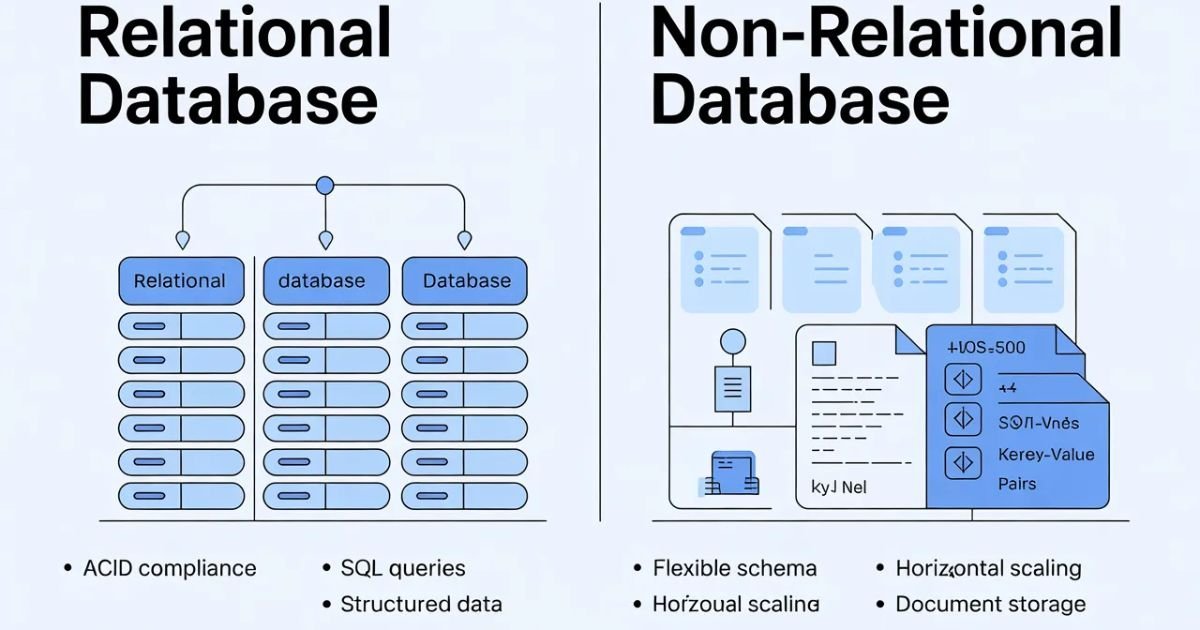
Structured tables consisting of rows and columns are used to store data in relational databases. A record is represented by each row, and a field within a record is represented by each column. The tables are "relational" in the sense that they can be linked to each other with keys, usually foreign and main keys. This technique works best with structured data that has a defined format and where it's crucial to understand the relationships between data items.
Structured Query Language (SQL) is used by relational databases to add, retrieve, update, and remove data. SQL is a sophisticated, standardized language that is widely used in industry and is simple to learn.
For instance:
Think about a mechanism for managing students. Student information may be stored in one database, course information in another, and a link to the students' registered courses in a third table. By joining these tables with student and course IDs, data management becomes accurate and consistent.

Popular relational databases include:
- MySQL
- PostgreSQL
- Oracle Database
- Microsoft SQL Server
What is a Non-Relational Database?
Non-relational databases, sometimes referred to as NoSQL databases, are made to manage data that is unstructured, semi-structured, or changes frequently. Non-relational databases don't keep data in fixed tables like relational databases do. Rather, they employ a variety of models, including wide-column stores, graphs, documents, and key-value pairs.
For large-scale, contemporary web applications where the data structure is inconsistent or changes frequently, non-relational databases are frequently chosen. High performance, simple scalability, and increased data modeling flexibility are all offered by these databases.
For instance, a student's record may be kept in a document that resembles JSON in a document-based NoSQL database like MongoDB. Without specifying a set structure, this document can include a variety of fields, including name, course, contact details, and even nested data.
Common non-relational databases include:
- MongoDB (Document-based)
- Redis (Key-Value store)
- Cassandra (Wide-column)
- Neo4j (Graph-based)
Key Differences Between Relational vs Non-Relational Databases
The main difference between relational and non-relational databases lies in how data is stored and organized. Relational databases rely on structured schemas and table relationships, while non-relational databases offer flexible structures that adapt to unstructured or evolving data.

Relational databases are ideal when data integrity and relationships are important. Non-relational databases, on the other hand, are optimized for performance, flexibility, and scale—making them suitable for modern web, mobile, and IoT applications.
Summary of differences:
- Data Structure: Relational databases use structured tables, while non-relational databases use flexible formats such as documents or key-value pairs.
- Schema: Relational databases have a fixed schema, whereas non-relational databases use dynamic or schema-less structures.
- Scalability: Relational databases scale vertically (by upgrading server hardware), while non-relational databases scale horizontally (by adding more servers).
- Relationships: Relational databases handle complex relationships naturally; non-relational databases may require workarounds or embedding.
- Query Language: SQL is the standard for relational databases; NoSQL databases use their own query formats depending on the type.
Pros and Cons of Relational Databases
Advantages:
- Strong consistency and integrity due to ACID properties (Atomicity, Consistency, Isolation, Durability).
- Well-suited for applications requiring structured data and complex relationships.
- Mature technology with strong community support and tools.
Disadvantages:
- Less flexible when dealing with changing data structures.
- Not ideal for handling large-scale, unstructured, or rapidly changing data.
- Scaling requires powerful hardware (vertical scaling), which can be expensive.
Pros and Cons of Non-Relational Databases
Advantages:
- Highly flexible and adaptable to different data types and structures.
- Excellent for horizontal scaling and distributed systems.
- Great performance with large volumes of data and real-time analytics.
Disadvantages:
- Weaker enforcement of data relationships and integrity.
- Different databases have different query languages and mechanisms.
- Not always suitable for applications requiring complex joins or strict consistency.
When Should You Use a Relational Database?
Choose a relational database when:
- You have structured data that doesn’t change often.
- You need strong consistency, accuracy, and data integrity.
- Your application requires complex joins and multi-table queries.
- Examples: banking systems, school management systems, payroll software, CRMs.
When Should You Use a Non-Relational Database?
Choose a non-relational database when:
- Your data is unstructured, semi-structured, or evolving frequently.
- You are building a system that must handle large volumes of data or user traffic.
- You need flexible, high-performance solutions that scale easily.
- Examples: social media feeds, real-time chat apps, IoT data platforms, content delivery systems.
What Do Employers Expect?
In interviews, recruiters often ask candidates:
- "What’s the difference between SQL and NoSQL?"
- "Which database would you choose for this project and why?"
- "How do you ensure data consistency in a distributed system?"
They’re not just looking for definitions. They want to see if you understand how database design affects application performance, scalability, and reliability.
At Checkmate IT Tech, we train students to answer these questions confidently—based on real-world project experience.
Frequently Asked Questions (FAQs)
1. Does SQL have any place in today's software development process?
Yes, there is a high demand for SQL. It serves as the basis for relational databases, which are still extensively utilized in essential systems and enterprise applications across several industries.
2. Is learning NoSQL simpler than learning SQL?
Because to its adaptable nature, NoSQL may seem simpler for straightforward use cases. It can be challenging to understand how to scale and administer NoSQL databases in production, though. SQL provides standardized commands and a better organized learning path.
3. Are SQL and NoSQL used together by businesses?
Indeed. Many businesses employ a polyglot persistence strategy, selecting various databases for various application components according to requirements. For instance, NoSQL is used for analytics and logging, and SQL is used for transaction management.
4. Which ought to be my first lesson?
Start with SQL. It is fundamental and necessary for practically all IT positions. Learning a NoSQL database, such as MongoDB, will enable you to work on more contemporary and scalable apps after you're at ease with SQL.
5. Does database knowledge matter in placement interviews?
Of course. Developers, analysts, and backend engineers need to be proficient in understanding database types, writing SQL queries, and determining when to utilize SQL or NoSQL. All of these subjects are covered in our placement-focused training at Checkmate IT Tech using actual projects.
In conclusion
The functions of relational and non-relational databases differ. They just address various issues; neither is superior nor inferior. It is your responsibility as a student, developer, or future IT professional to comprehend the distinctions, know when to apply each one, and show that understanding in interviews and practical projects.
We make this simple at Checkmate IT Tech. We provide relational (MySQL, PostgreSQL) and non-relational (MongoDB, Redis) database training through practical projects, assignments, and simulated interviews in our training programs for Full Stack Development, Data Engineering, and Backend Technologies.
Do you want to develop actual projects and prepare for placement by honing your database skills? Come be a part of our next group. Learn by doing. Get a job by demonstrating yourself.