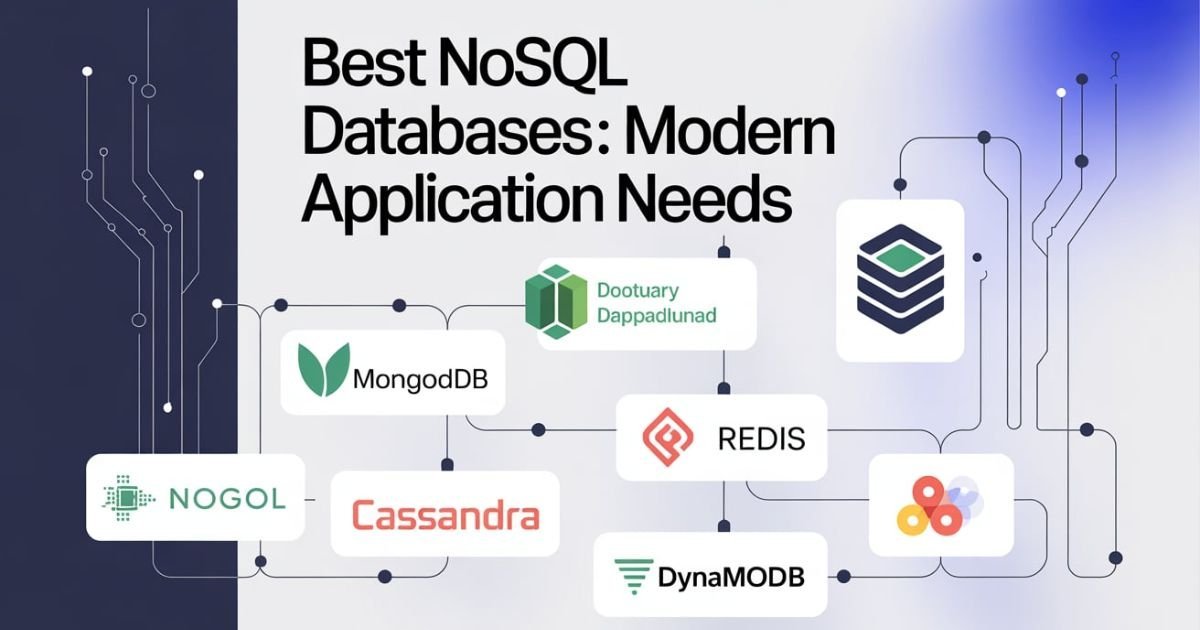
Applications are created more quickly than ever before in the fast-paced digital world of today, and they must scale, change, and adapt instantly. Conventional relational databases sometimes fall behind due to their complicated joins and strict schema. Best NoSQL Databases can help with it. Modern apps benefit greatly from their flexibility, speed, and scalability, particularly when handling massive data sets or frequently changing their structure.

Understanding NoSQL is crucial if you're a developer, student, or someone looking at backend technology for your project or startup. Additionally, knowing which option to select is equally crucial if you're considering constructing a NoSQL database.
Let's examine the top document-oriented database choices you should think about and dissect what NoSQL is all about.
Really, what is NoSQL?
"NoSQL" does not imply "no SQL". All it stands for is "Not Only SQL," indicating that these databases are not dependent on the rigid table-based architecture of conventional relational databases. Rather, they enable the storage of data in a variety of formats, including columns, graphs, key-value pairs, and, most frequently, documents.
Because of this flexibility, you can model your data to closely resemble the way your application uses it. Your items no longer need to be forced into rows and columns.
Why Developers Love NoSQL
Whether you're building an e-commerce site, a social media platform, a real-time analytics dashboard, or even a learning management system for your training platform, NoSQL gives you these key benefits:
- Flexible Schema: Change or add fields without breaking your app.
- Scalability: Easy to scale out across multiple servers.
- High Performance: Optimized for read/write operations at scale.
- Natural Data Mapping: Easier to map application data structures directly into the database.
Types of Best NoSQL Databases:
Before we dive into the best document oriented database, it's good to understand the four main types of NoSQL databases:
- Document-Oriented Databases – Store data as structured documents, usually in JSON or BSON.
- Key-Value Stores – Simplest type, just a key and a value.
- Column-Family Stores – Store data in columns instead of rows, great for analytical workloads.
- Graph Databases – Designed for managing highly interconnected data (e.g., social networks).
Our focus here is on document-oriented databases, as they offer the best mix of structure and flexibility for most modern applications.
What is a Document-Oriented Database?

Imagine storing a user profile like this:
{
"userId": "u123",
"name": "John Doe",
"email": "john@example.com",
"skills": ["Java", "Python", "MongoDB"],
"education": {
"degree": "B.Tech",
"year": 2022,
"university": "XYZ University"
}
}
This is what a document looks like in a document-oriented database. It’s self-contained, easy to read, and matches your application object exactly. No tables, no joins, no foreign keys—just the data you need, ready to use.
Top 5 Best Document Oriented Databases
Let’s explore the best document-oriented database options available in 2025. Each has its unique strengths and use cases.
1. MongoDB
MongoDB is the most widely adopted document database. It stores data in flexible, JSON-like documents and is perfect for applications that need rapid development and scalability.
Why Choose MongoDB:
- Schema-less design
- Built-in replication and sharding
- Strong community and ecosystem
- Great for prototyping and large-scale production
Use Cases:
- E-commerce platforms
- Learning management systems
- User profile management
- Content-driven apps
If you're designing a NoSQL database from scratch, MongoDB is often the go-to option due to its versatility and ease of use.
2. Couchbase
Couchbase combines the power of a document store with the performance of a key-value database. It supports offline-first apps and provides built-in caching, full-text search, and real-time analytics.
Why Choose Couchbase:
- High availability and low latency
- Mobile sync capabilities
- Built-in search and analytics
Use Cases:
- Real-time analytics platforms
- Mobile apps
- Session storage for web apps
3. RavenDB
RavenDB is a native .NET document database, making it perfect for enterprises using Microsoft technologies. It provides transactional integrity, a graphical interface, and supports advanced data queries.
Why Choose RavenDB:
- Easy to integrate with .NET
- Visual tools for managing documents
- High performance with ACID transactions
Use Cases:
- Enterprise applications
- Financial software
- Document-heavy workflows
4. CouchDB
If simplicity and reliability are your priorities, CouchDB is worth a look. It’s known for its multi-master replication and offline support.
Why Choose CouchDB:
- Excellent support for syncing data between clients and servers
- Simple RESTful API
- Tolerant to network failures
Use Cases:
- Offline-first mobile/web apps
- Remote data collection apps
- Distributed environments
5. ArangoDB (Honorable Mention)
While technically a multi-model database, ArangoDB shines as a document store as well. It also supports graph and key-value models in the same engine.
Why Choose ArangoDB:
- Multi-model support
- Joins across collections (rare in NoSQL)
- Great for hybrid applications
Key Considerations When Designing a NoSQL Database
Picking the right NoSQL tool is only half the job. The real power lies in designing a NoSQL database that’s optimized for your application needs. Here are the key principles to keep in mind:
1. Start With Your Queries
Don’t model your data based on what it looks like model it based on how you plan to use it. Think in terms of:
- What will the user see?
- What data needs to be fetched together?
- Which operations happen most frequently?
Build your documents to support these queries efficiently.
2. Decide Between Embedding and Referencing
- Embedding means placing related data inside the same document (e.g., user and addresses).
- Referencing means storing related data in separate documents and linking them by IDs.
Use embedding for closely related, rarely updated data. Use referencing for shared or frequently updated data.
3. Plan for Growth and Scale
If you expect a large user base or high data volumes:
- Choose a shard key wisely.
- Avoid creating massive documents (some databases have size limits).
- Optimize your indexes early.
4. Think About Consistency and Transactions
Not all NoSQL databases handle transactions like relational databases. If your app needs strong consistency (e.g., for payments or legal records), choose a database that supports ACID features or know how to implement them manually.
5. Use Schema Validation (Yes, Even in NoSQL)
While NoSQL is schema-less, it doesn't mean "structure-less." Most modern document databases allow schema validation. Use it to enforce required fields and data types. This ensures data quality while keeping flexibility.
6. Secure Your Data
Always:
- Use authentication and access control.
- Enable encryption at rest and in transit.
- Monitor logs and backups regularly.
Security should never be an afterthought.
Common Mistakes to Avoid
When teaching NoSQL or building your own systems, avoid these common mistakes:
- Designing like a relational database – Don't normalize unnecessarily.
- Ignoring data access patterns – You’ll end up with slow queries and complex workarounds.
- Over-embedding – Large documents become unmanageable.
- No indexes – Your app will crawl under load.
- No backup or replication – Disaster waiting to happen.
Real-World Example: Training and Placement App
Imagine you’re building a training and placement portal—like CheckmateITTech. Here's how you might structure your documents:
User Document:
{
"userId": "stu001",
"name": "Ayesha Khan",
"role": "student",
"email": "ayesha@gmail.com",
"skills": ["Python", "Machine Learning"],
"certifications": ["AWS", "Google Cloud"],
"applications": [
{
"jobId": "job789",
"status": "applied",
"appliedOn": "2025-09-01"
}
]
}
Job Document:
{
"jobId": "job789",
"company": "TechFusion",
"title": "Data Analyst",
"requirements": ["Python", "SQL"],
"location": "Remote",
"postedOn": "2025-08-15"
}
This structure keeps data organized and readable while supporting fast queries like:
- List all jobs a student applied to.
- Find students with specific certifications.
- Match jobs based on skills.
Final Thoughts: Which One Should You Choose?
There’s no universal answer to the best document oriented database, but here’s a quick guide:
- MongoDB – Great all-rounder; best for most web/mobile applications.
- Couchbase – Go-to if you need speed, caching, and mobile sync.
- RavenDB – Best fit for .NET-based enterprise environments.
- CouchDB – Choose for offline-first, distributed environments.
- ArangoDB – Ideal if you want to explore multi-model databases.
If you’re training students or building something from scratch, start with MongoDB. It’s widely used in the industry, beginner-friendly, and well-documented.
Bonus Tip for Students and Professionals
If you're preparing for a backend developer or full stack role, learning how to design and optimize NoSQL databases is a great advantage. It's not just about using MongoDB commands—it's about understanding when and why to use certain structures, embedding strategies, and index types.
Mastering designing a NoSQL database will give you a strong edge in interviews and real-world projects.