
Cybersecurity is one of those fields where everyone agrees the demand is real, but almost nobody starting out knows what to actually do first. Should you jump straight into ethical hacking? Is CISSP the one everyone talks about? Do you need a degree, or can certifications alone get you hired? If you've been Googling "cybersecurity roadmap" at 1 a.m. trying to make sense of a dozen conflicting blog posts, this article is meant to cut through that noise.

We'll walk through a realistic, stage-by-stage certification path for beginners, what each stage is actually good for, common mistakes people make (like jumping straight to CISSP), and where structured training fits into all of it. This isn't theory pulled from a textbook it reflects how the industry, and training providers like Checkmate IT Tech, actually see beginners move from zero experience into their first cybersecurity role.
Why Cybersecurity Is Worth the Effort Right Now
Before getting into the roadmap itself, it's worth understanding why this field keeps showing up on every "best careers" list. The honest answer is a persistent skills gap. In 2025, more than half of security leaders cited a lack of skilled cybersecurity professionals as a high-impact challenge for their organizations, and many responded by raising compensation, investing more heavily in training, and leaning on external partners to fill roles they couldn't staff internally, according to KPMG's 2025 research. That gap hasn't closed if anything, it's widened as more organizations move critical systems online and attackers get more sophisticated.
That combination high demand, limited supply of qualified people is exactly the environment where a well-planned certification path pays off fastest.
The Big Mistake Beginners Make
Before the roadmap, one warning: don't start with the "impressive" certifications. A lot of beginners see CISSP or CEH mentioned everywhere and assume that's the goal. In reality, CISSP requires five years of relevant work experience just to qualify for full certification, and CEH while accessible sooner is a bigger financial and time investment than most total beginners need for their first credential. Chasing a senior-level certification before you have the foundation (or the job) to use it is the single most common way people waste money and burn out early.
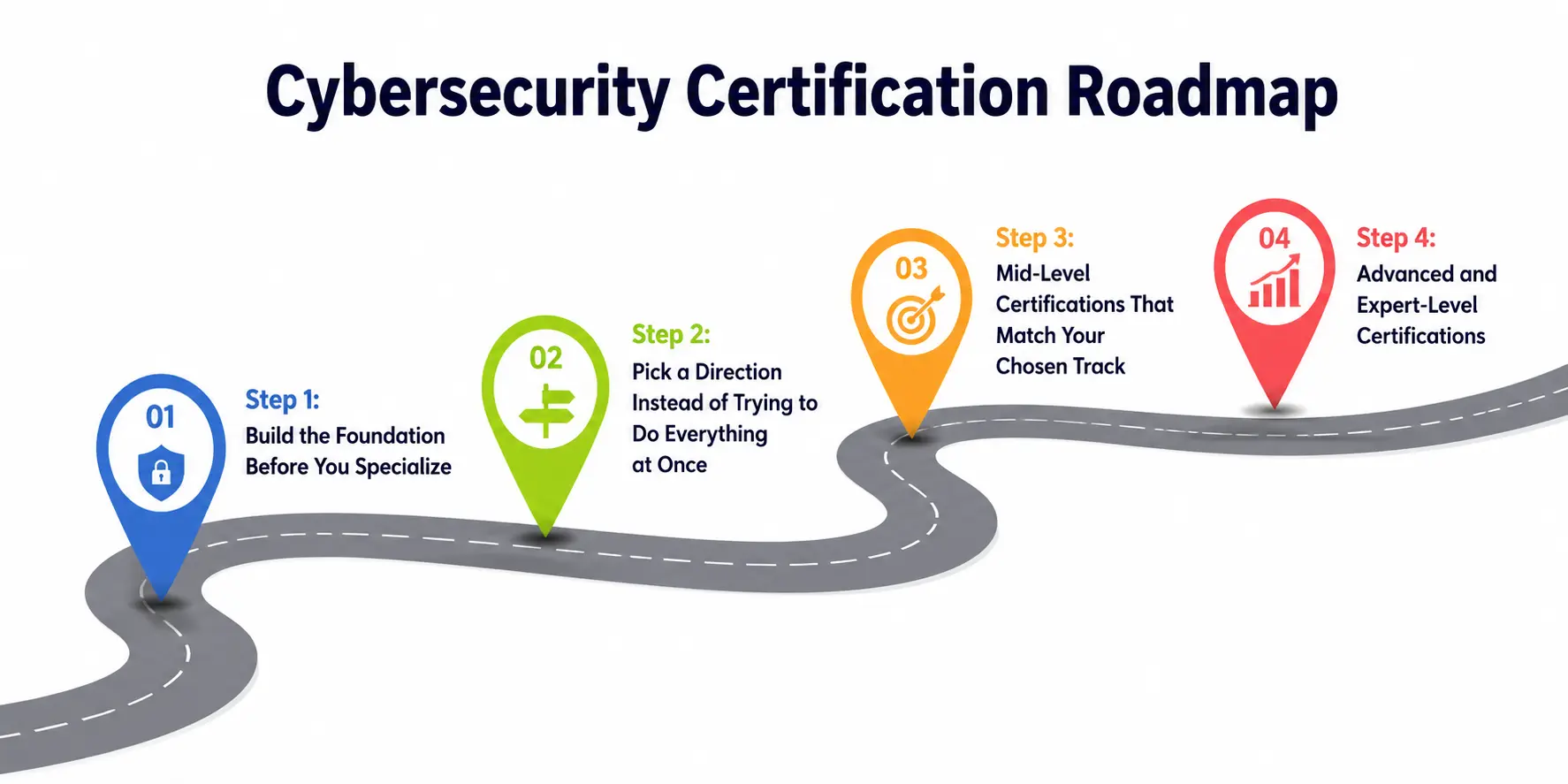
The right approach is sequential: build the foundation, get hired, then specialize.
Stage 1: Total Beginner Build the Foundation
If you're coming from outside IT entirely no help desk experience, no networking background — start here before jumping into a security-specific certification.
What to focus on: basic networking concepts (how data moves across a network), fundamental operating system knowledge (Windows and Linux basics), and general IT literacy. Some beginners take an entry-level credential like the Google Cybersecurity Certificate or CompTIA's Tech+ at this stage purely to build vocabulary and confidence before their first real security exam.
Why this stage gets skipped, and shouldn't. It's tempting to jump straight to Security+ because it's "the" beginner cybersecurity cert everyone recommends. But if you don't understand basic networking ports, protocols, how a firewall actually works the material won't stick, and you'll be memorizing terms instead of understanding them. A short foundational course or even self-study here saves real time later.
This is also where structured training makes the biggest difference for people without an IT background. Cybersecurity training programs built for beginners typically start exactly here foundational security concepts, threat landscapes, and the vocabulary that later certifications assume you already know rather than throwing you straight into exam-cram mode.
Stage 2: Get Hired The Entry-Level Standard
This is the stage that matters most, because it's the one that actually gets you a job.
CompTIA Security+ is the near-universal first real certification for anyone serious about a cybersecurity career. It's vendor-neutral, widely recognized, and covers the exact vocabulary that SOC (Security Operations Center) analyst job postings screen for things like SIEM tools, incident response basics, and common attack types. It's also DoD 8570/8140-recognized, which matters a lot if you're interested in defense-adjacent or government-contracted roles. Typical salary ranges tied to Security+-level roles commonly fall in the $75,000–$110,000 range depending on role and location, and some data suggests certified professionals see meaningfully higher pay than non-certified peers doing similar work.

If your goal is specifically security testing or vulnerability-focused work rather than general SOC analysis, this is also the point where it's worth pairing Security+ knowledge with hands-on, practical training. A Security Testing certification program focused on vulnerability scanning, penetration testing fundamentals, and secure coding practices gives you the applied skills that a multiple-choice exam alone doesn't teach and hiring managers notice the difference between someone who passed a test and someone who's actually touched the tools.
What to pair with it: a home lab. Set up a basic virtual environment, practice analyzing logs, experiment with a free SIEM tool. Interviews at this level are increasingly testing for hands-on instinct, not just the ability to recite definitions.
Stage 3: Grow Specialize and Deepen
Once you have Security+ (or equivalent) and some real experience even six months to a year in an entry-level security or IT role it's time to specialize.
A few realistic branches at this stage:
- CySA+ (CompTIA Cybersecurity Analyst) if you're leaning toward SOC analyst or threat detection work, this builds directly on Security+ knowledge.
- CEH (Certified Ethical Hacker) if offensive security, penetration testing, or government/defense-adjacent roles interest you. Note this one requires either two years of information security experience or completion of official training, so it's genuinely a second-stage certification, not a starting point.
- Vulnerability management specialization if you're drawn to the "find the weakness before someone else does" side of security. A structured Vulnerability Management training program covers scanning tools, risk assessment, and remediation workflows that map directly to Vulnerability Analyst and Security Consultant roles.
- Cloud security fundamentals (AWS Security Specialty or Azure's AZ-500) increasingly valuable as more infrastructure moves to the cloud, though this pays off most once you have some cloud platform exposure already.

This is also a reasonable point to pick up a specialized tool-based certification if your target employer uses a specific platform. Privileged Access Management, for instance, is a real and growing niche CyberArk training is a good example of a focused, tool-specific credential that security consultants and IT administrators use to stand out in finance, healthcare, and government sectors where PAM compliance is taken seriously.
Stage 4: Senior and Leadership Track
This stage isn't really "beginner" territory, but it's worth knowing where the roadmap eventually leads, so you can plan backward.
CISSP (Certified Information Systems Security Professional) sits at the top of most roadmaps for a reason it signals broad expertise across risk management, architecture, and governance. But it requires five years of relevant experience to hold the full certification (you can sit the exam earlier and hold "Associate of ISC2" status while you accumulate the required experience). This is not a first-year goal.
CISM (Certified Information Security Manager) is the parallel path for people heading toward security leadership and management rather than deep technical specialization.
The pattern across nearly every credible roadmap is consistent: higher-level certifications correlate with higher pay, but mostly because they're held by more experienced professionals — not because the certification itself adds some fixed salary bonus on its own. Pay follows experience and role far more than it follows the number of letters after your name.
A Realistic Beginner-to-Job Timeline
To put this all together in a way that's actually usable:
- Months 1–3: Foundational networking and IT literacy, plus an intro-level cybersecurity course if you're coming from outside tech.
- Months 3–6: Study for and pass CompTIA Security+. Build a basic home lab alongside it.
- Months 6–9: Apply for entry-level roles SOC Analyst I, IT Security Support, Junior Security Analyst while continuing hands-on practice.
- Year 1–2 (post-hire): Choose a specialization analyst track (CySA+), offensive security (CEH), or a tool-specific niche based on what your actual job exposes you to.
- Year 3+: Consider cloud security certifications or begin planning toward CISSP/CISM as your experience accumulates.
This timeline isn't fixed in stone some people move faster with focused, full-time study, and some move slower while working another job in parallel. But the sequence itself foundation, entry credential, hands-on experience, specialization, leadership holds up regardless of pace.
Common Pitfalls to Avoid
Starting with CISSP or CEH. Both are too advanced and too expensive for a first credential. Begin with Security+.
Collecting certifications instead of experience. A home lab, real hands-on projects, and your first job will do more for your career than a stack of unused credentials. Employers increasingly want to see applied skill, not just exam pass rates.
Ignoring the experience requirements. CISSP specifically requires five years of relevant experience plan your path around that instead of being surprised by it later.
Self-studying everything in isolation. It's possible to prepare for each certification individually through free resources, but it's slower, and exam vouchers alone can add up to several thousand dollars across a full certification path with no safety net if you fail. A structured training program that bundles certification prep, instructor support, and hands-on labs together tends to be far more efficient and far less lonely than trying to piece together your own curriculum from scattered tutorials and outdated blog posts.
Where Structured Training Fits In
Everything above is genuinely doable through self-study if you have the discipline and the time to sort good resources from bad ones. But most beginners underestimate how much time gets lost just figuring out what to study next, which labs actually matter, and how to translate certification knowledge into interview-ready hands-on skill.
That's the specific gap a training and placement provider is built to close. Checkmate IT Tech's cybersecurity-focused programs are structured around this exact roadmap — starting with foundational concepts for true beginners, moving into practical security testing and vulnerability management training with real labs and simulations, and offering tool-specific tracks like CyberArk for learners who want to specialize once they've got the fundamentals down. If you're not sure exactly which stage fits your current background, it's worth browsing the full catalog of IT and cybersecurity courses to see how the different tracks connect before committing to one.
Final Thoughts
A cybersecurity career doesn't require you to memorize every certification acronym in the industry or chase the most impressive-sounding credential first. It requires a sequence: build the foundation, earn the entry-level standard (Security+, for almost everyone), get real hands-on experience, and then let your actual job and interests guide which specialization comes next. The people who burn out or waste money in this field are usually the ones who skipped steps, not the ones who moved too slowly. Give yourself permission to start at the beginning, treat certifications as tools rather than trophies, and build genuine hands-on skill alongside every exam you take. The demand for capable cybersecurity professionals isn't slowing down the roadmap above just makes sure you're actually ready when the opportunity shows up.
Frequently Asked Questions
1. What is the best first cybersecurity certification for a total beginner?
CompTIA Security+ is the near-universal recommendation as a first real certification. If you have zero IT background, a foundational course covering basic networking and security concepts before Security+ will make the material much easier to absorb.
2. Do I need a college degree to start a career in cybersecurity?
No. Many cybersecurity professionals enter the field through certifications and hands-on training rather than a formal degree. Certifications like Security+ exist specifically to let employers verify your skills independently of a degree.
3. How long does it take to become job-ready in cybersecurity?
With focused study, many beginners reach job-readiness for entry-level roles (like SOC Analyst I) within six to nine months, combining foundational learning, Security+ preparation, and hands-on lab practice.
4. Should I get CEH before or after Security+?
After. CEH generally requires either two years of information security experience or completion of official training, making it a second-stage certification rather than a starting point.
5. Is CISSP worth pursuing as a beginner?
Not as a first certification. CISSP requires five years of relevant work experience for full certification status, so it's a mid-to-senior career goal, not a beginner one. You can take the exam early and hold Associate status while accumulating experience.
6. How much can I expect to earn with an entry-level cybersecurity certification?
Pay varies by role and location, but Security+-aligned entry roles commonly fall in the $75,000–$110,000 range, with some data showing a meaningful salary boost for certified professionals compared to non-certified peers.
7. What's the difference between Security+ and CySA+?
Security+ is a broad, foundational certification covering core security concepts. CySA+ builds on that foundation with a deeper focus on threat detection, analysis, and incident response, making it a natural next step after some entry-level experience.
8. Is self-study enough, or should I take a structured training program?
Self-study is possible but often slower and more expensive in the long run, especially when factoring in exam voucher costs and the risk of failing without structured support. A guided training program with labs, instructor support, and certification prep tends to get beginners job-ready faster.
9. What skills matter most alongside certifications for landing a first cybersecurity job?
Hands-on lab experience analyzing logs, working with a SIEM tool, practicing basic penetration testing in a safe environment matters as much as the certification itself. Interviews increasingly test for applied instinct, not just memorized definitions.
10. What cybersecurity specializations are in the highest demand right now?
SOC analysis, vulnerability management, cloud security, and penetration testing consistently rank among the highest-demand specializations, driven by the ongoing shortage of skilled security professionals across nearly every industry.