
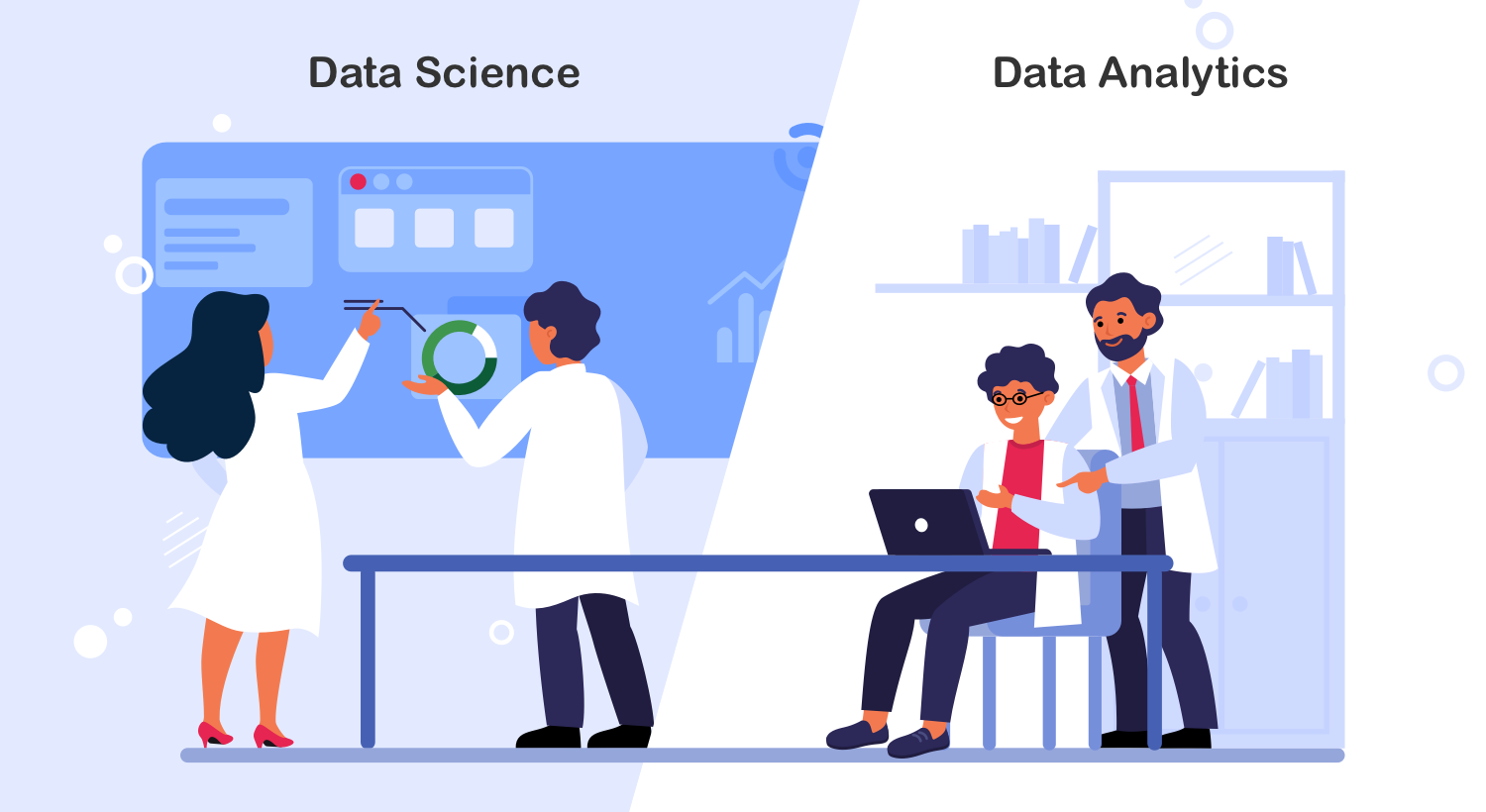
"Should I become a data analyst or a data scientist?" This is one of the most common questions we hear at Checkmate IT Tech (checkmateittech.com) from students starting their journey into the data field. And it's a fair question the two titles get used almost interchangeably online, job postings blur the lines further, and half the "explainer" articles out there just repeat the same vague definitions without actually helping you decide anything.

So let's actually clear this up. This article breaks down what each role really does, how the pay and career paths compare, and just as importantly how to actually build the right skills for whichever path fits you, instead of guessing your way through free tutorials and hoping it works out.
The Core Difference, in Plain Language
Here's the simplest way to think about it: data analysts explain what already happened. Data scientists predict what's going to happen next.
A data analyst looks at existing data sales numbers, website traffic, customer behavior and turns it into reports, dashboards, and insights that help a business understand its current situation. A data scientist goes a step further: they build predictive models and machine learning systems that forecast future outcomes, recommend actions, or even automate decisions.
Put another way if a business asks "why did sales drop last month?", that's a data analyst question. If they ask "what will sales look like next quarter, and what should we do about it?", that's a data scientist question.
Data Analyst: Role, Skills, and Day-to-Day Work
A data analyst's job typically revolves around:
- Cleaning and organizing messy data so it's usable
- Writing SQL queries to pull the exact information decision-makers need
- Building dashboards and visualizations in tools like Tableau or Power BI
- Spotting trends and patterns in existing datasets
- Presenting findings to non-technical stakeholders in a way they can actually act on
Core tools: SQL, Excel, Tableau or Power BI, and often a working knowledge of Python for deeper analysis.
Education baseline: A bachelor's degree in any quantitative field is common, but a growing number of analysts today come through structured, hands-on training programs instead of a traditional four-year degree especially for entry-level roles where employers care more about your practical SQL and dashboarding skills than your diploma.
Data Scientist: Role, Skills, and Day-to-Day Work
A data scientist's job typically involves:
- Building and training machine learning models
- Running statistical experiments and hypothesis testing
- Working with large, often messy datasets that need serious cleaning and structuring before any modeling can happen
- Collaborating with engineering and product teams to deploy models into real products
- Translating complex model outputs into business recommendations
Core tools: Python (pandas, scikit-learn, TensorFlow or PyTorch), R, SQL, and cloud-based notebooks.
Education baseline: A bachelor's degree is often the minimum expectation, and a strong grasp of statistics and machine learning is essential a master's degree is common in this field, though it's increasingly possible to break in through project-based training and portfolio work instead of formal postgraduate study.
Salary Comparison: What the Data Actually Shows
Salary numbers vary depending on the source, but the pattern is consistent everywhere you look:
- The Bureau of Labor Statistics reports a median salary of roughly $108,020 for data scientists in the U.S., compared to about $83,640 for data analysts, based on May 2024 data.
- Entry-level data scientists typically start in the $75,000–$100,000 range, while entry-level data analysts commonly start closer to $60,000–$90,000.
- Job growth is strong for both roles, but data scientist roles are projected to grow around 36% between 2023 and 2033 noticeably faster than most other occupations while data analyst roles are also growing well above the national average.
The honest takeaway here: data science pays more on average, but data analyst roles are the faster, lower-friction way into the field, especially if you're starting without a technical background.
Which Path Should You Actually Choose?
This depends less on which job "sounds cooler" and more on your current starting point and what kind of work genuinely interests you.
Choose data analyst if:
- You want to enter the data field faster, with a shorter learning curve
- You enjoy working with business questions, dashboards, and clear, explainable insights
- You're comfortable with SQL and visualization tools but not yet ready for heavy statistics or machine learning
- You want a realistic path to a $60K–$90K starting role within months rather than years
Choose data science if:
- You're comfortable with (or willing to learn) statistics, probability, and programming in depth
- You're interested in building predictive models, not just reporting on existing data
- You're aiming for a stronger long-term salary ceiling and are willing to put in more study time upfront
- You already have some analytical or programming background to build on
Many professionals actually start as data analysts and move into data science later, once they've built a foundation in SQL, Python, and business context. This is one of the most common and realistic career paths in the entire data field.
Why Self-Study Alone Usually Isn't Enough
Here's something worth being honest about: a huge number of people try to learn data analysis or data science entirely through free YouTube videos, scattered blog posts, and random online courses and a lot of them get stuck. Not because the material isn't out there, but because self-study on its own has real gaps that hurt you when it actually matters:
- No structured order. Free content jumps around topics randomly. You end up learning advanced concepts before you've mastered the basics, or missing foundational skills entirely without realizing it.
- No real project experience. Employers want to see that you've actually applied these skills to a real, structured project not just watched tutorials. Self-taught learners often have gaps here that show up immediately in interviews.
- No feedback or correction. When you're stuck or doing something wrong, there's no instructor to correct you. Small misunderstandings pile up and become bad habits that are hard to unlearn later.
- No placement support. Even if you do learn the skills, self-study gives you nothing when it comes to actually landing interviews, building a resume that passes screening, or connecting with employers who are hiring right now.
This is exactly why structured, guided training consistently outperforms self-study for people who are serious about actually getting hired not just learning for the sake of learning.
Why Train With Checkmate IT Tech Instead of Going It Alone
This is the honest, direct answer to a question a lot of students ask us: "Can't I just learn this myself for free?"
You can try. But here's what training with Checkmate IT Tech (checkmateittech.com) actually gives you that free, scattered self-study can't:
- A structured curriculum built specifically for beginners, so you learn SQL, Python, statistics, and tools like Tableau or Power BI in the right order — not randomly.
- Hands-on, real-world projects you can actually show employers, instead of a resume with no proof you can do the job.
- Instructor support, so when you're stuck or confused, you get a real answer instead of endless forum searching.
- Placement support after training, which is the single biggest gap in self-study. Learning the skill is only half the job actually getting hired is the other half, and that's exactly where most self-taught learners get stuck.
If you're weighing the data analyst path, our Data Analyst Certification program is built to take you from the basics SQL, Excel, and dashboarding all the way to a job-ready skill set, with real project work along the way.
If you're leaning toward the more technical, predictive side of the field, our Big Data Analytics course helps build the foundation you'll need before moving into machine learning and advanced data science work.
Since AI and machine learning are now core to almost every data science role, our Artificial Intelligence training program is a natural next step once you're comfortable with the data fundamentals it's exactly the kind of skill gap that separates a data analyst resume from a data scientist resume.

If you're not sure yet which path fits you best, browsing our full course catalog is a good way to compare data analytics, big data, AI, and related tracks side by side before committing to one.
And if you want to know more about who we are and how our training and placement process actually works, our About Us page walks through it in detail.
The bottom line: you can try to piece this together for free. But if you're serious about actually landing a data role not just understanding the concepts in theory structured training with real project work and placement support, like what we provide at Checkmate IT Tech, is simply the faster, more reliable route. Free tutorials teach you concepts. Training gets you hired.
Final Thoughts
Data analyst and data scientist roles both sit inside the same broader data field, but they solve different problems one explains the present, the other predicts the future. Data analyst roles offer a faster, more accessible way into the field, while data science offers a higher salary ceiling for those willing to go deeper into statistics, programming, and machine learning. Either path is a genuinely smart career move in 2026, given how fast both roles are growing.
What actually determines your success isn't just which title you pick it's how well you build the underlying skills, and how effectively you can prove them to employers. That's the part free, scattered self-study almost always falls short on, and it's exactly the gap that structured training and placement support, like what we offer at Checkmate IT Tech (checkmateittech.com), is built to close. If you're serious about breaking into data analytics or data science, don't just learn learn with a plan, build real projects, and get the placement support that actually gets you hired.
Frequently Asked Questions
1. What is the main difference between a data analyst and a data scientist?
Data analysts examine existing data to explain what happened and support business decisions. Data scientists build predictive models using machine learning and statistics to forecast future outcomes.
2. Who earns more, a data analyst or a data scientist?
Data scientists typically earn more. U.S. median salaries are roughly $108,020 for data scientists versus around $83,640 for data analysts, based on recent Bureau of Labor Statistics data.
3. Is it easier to become a data analyst than a data scientist?
Yes, generally. Data analyst roles require a narrower, more accessible skill set (SQL, Excel, visualization tools), while data science requires deeper statistics, programming, and machine learning knowledge.
4. Can I become a data analyst without a degree?
Yes. Many entry-level data analyst roles today prioritize demonstrated skills SQL, dashboarding, real project experience over a formal degree, especially for candidates who complete structured, hands-on training.
5. Can a data analyst become a data scientist later?
Yes, this is a very common career path. Many data scientists started as data analysts and built up their statistics, Python, and machine learning skills over time before transitioning.
6. What tools should I learn first for a data career?
SQL and Excel are the best starting point for either path. From there, data analysts typically add Tableau or Power BI, while data scientists move into Python, statistics, and machine learning frameworks.
7. Why should I take a structured training course instead of learning for free online?
Free content is often unstructured and lacks real project work, feedback, or placement support. Structured training programs teach skills in the right order, provide real projects for your resume, and help you actually get hired not just learn concepts in theory.
8. How long does it take to become job-ready as a data analyst?
With focused, structured training, many beginners become job-ready within a few months, depending on their starting point and how much time they can dedicate to learning.
9. Does Checkmate IT Tech offer placement support after training?
Yes. Checkmate IT Tech's programs are built as training and placement programs, meaning support doesn't stop once you finish learning the skills the goal is helping you actually land a job.
10. Which industries hire the most data analysts and data scientists?
Finance, healthcare, e-commerce, technology, and retail are among the biggest hirers for both roles, since nearly every modern business now relies on data to make decisions.