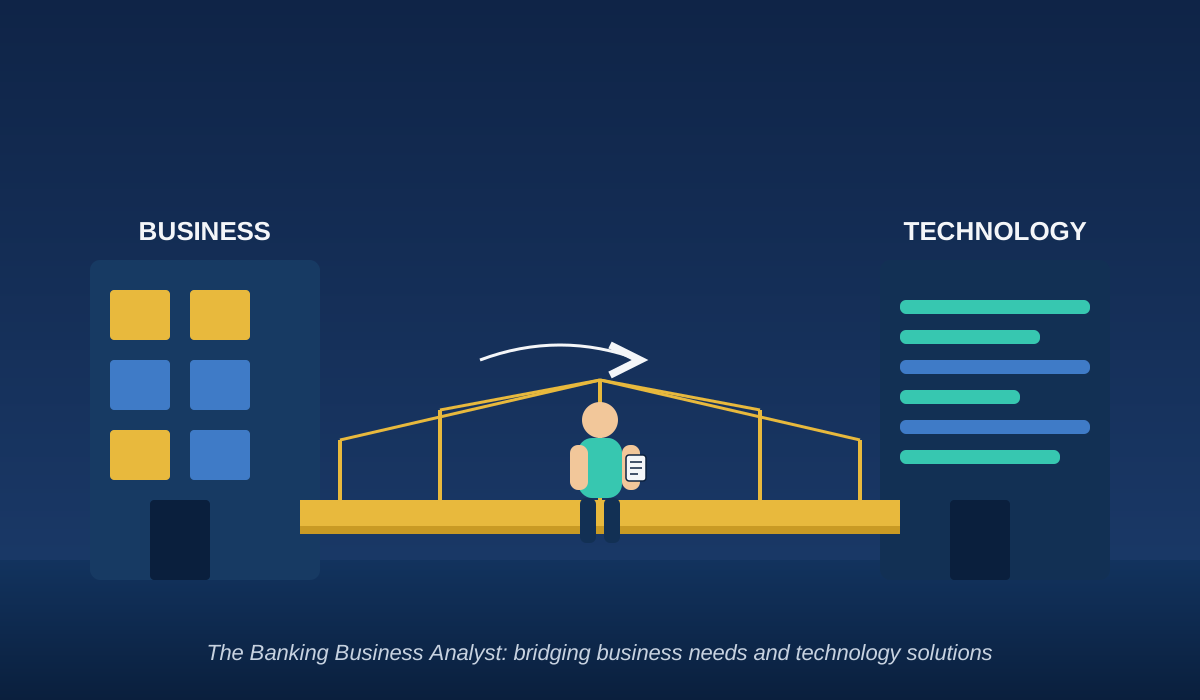
If you've ever sat in on a bank's project meeting, you've probably noticed one person in the room who somehow understands both what the compliance team is worried about and what the developers are building. That person is usually the Banking Business Analyst. They're not a coder, and they're not a banker in the traditional sense either. They're the translator, the note-taker who actually matters, and often the one person who catches a problem before it becomes an expensive mistake.
 Every banking project starts with the right questions, not the first answer.
This article is for anyone who's curious about what a Banking Business Analyst (BA) actually does day to day, what skills you genuinely need, and whether this could be a smart career move for you. No jargon-heavy corporate-speak. Just a straight, honest look at the role.
Who Is a Banking Business Analyst, Really?
A Banking Business Analyst sits between the business side of a bank think operations, risk, compliance, customer service and the technology side that builds and maintains the systems banks run on. Their job is to figure out what the bank actually needs, write it down in a way developers can build from, and then make sure what gets built actually solves the original problem.
Banks are complicated. You've got core banking systems, loan origination platforms, payment gateways, fraud detection tools, regulatory reporting requirements, and a dozen other moving parts, all of which need to talk to each other without breaking. A Banking BA is the person who keeps that whole conversation coherent.
Unlike a general business analyst, someone in banking also has to understand:
- How regulations like Basel III, AML (Anti-Money Laundering), KYC (Know Your Customer), and Dodd-Frank actually affect day-to-day operations
- How core banking platforms like Finacle, FIS, or Temenos function
- The lending lifecycle, from loan origination to servicing and collections
- Payment systems, card processing, and settlement flows
- Risk management frameworks that keep a bank solvent and out of regulatory trouble
That's a lot of domain knowledge layered on top of standard BA skills, and it's exactly why banking BAs are paid well and hired steadily, even when the broader tech job market slows down.
The Day-to-Day: What a Banking Business Analyst Actually Does
Here's where most articles get vague. Let's not do that. Below is what actually fills a Banking BA's calendar.
1. Requirements Gathering (The Real Starting Point)
Before any system gets touched, someone has to sit down with stakeholders branch managers, compliance officers, credit risk teams, sometimes even customers and figure out what the actual problem is. This isn't just "write down what they say." A good BA asks follow-up questions, challenges assumptions, and digs until the real requirement surfaces, because what people first ask for and what they actually need are often two different things.
2. Writing Business Requirement Documents (BRDs) and Functional Specifications
Once requirements are clear, they get documented. A BRD explains the business problem and the desired outcome. A Functional Specification Document (FSD) goes further and describes exactly how the system should behave. These documents become the contract between business teams and developers, so precision matters. A vague BRD leads to a built product nobody actually wanted.
 Finding the gap between how things work now and how they should work.
3. Process Mapping and Gap Analysis
Banking BAs frequently map out "as-is" processes (how things work now) versus "to-be" processes (how they should work after a change). This is where flowcharts, swimlane diagrams, and process models come in. The gap between the two tells the project team exactly what needs to change and why.
4. Working Directly With Compliance and Risk Teams
This is the part that separates a banking BA from a generic one. Every system change in a bank has to be checked against regulatory requirements. A BA working on a new loan product, for instance, needs to make sure interest calculation logic complies with lending regulations, that disclosures are accurate, and that reporting to regulators still works correctly after the change.
5. Liaising Between Business Stakeholders and the Tech Team
A BA doesn't disappear once requirements are handed off. They stay in the loop through development, answering questions from developers, clarifying edge cases, and making sure nothing gets lost in translation. This is often described as being the "bridge," and it's not an exaggeration — a BA who checks out after the requirements phase is doing half a job.
6. Testing Support and User Acceptance Testing (UAT)
Once a feature is built, someone needs to verify it actually does what was asked. Banking BAs write test cases, participate in UAT, and validate that the system behaves correctly across normal scenarios and edge cases because in banking, an edge case missed in testing can mean real money moving incorrectly.
7. Stakeholder Communication and Reporting
BAs regularly update stakeholders on project status, risks, and timelines. This includes running meetings, preparing status reports, and sometimes managing expectations when a project hits a snag (which, in any bank IT project, it eventually will).
8. Data Analysis and Reporting
Banking runs on data transaction volumes, default rates, customer segmentation, fraud patterns. BAs are often asked to pull data, build reports, and provide insights that inform business decisions, frequently using SQL, Excel, or BI tools like Tableau or Power BI.
Core Skills a Banking Business Analyst Needs
 From Junior BA to Lead BA a career path with room to climb.
If you're thinking about moving into this field, here's what actually gets you hired, based on what banking employers consistently ask for:
Domain knowledge: Understanding of banking products (loans, deposits, cards, payments), regulatory frameworks, and how a bank makes money.
Documentation skills: Writing clear, unambiguous BRDs, FSDs, user stories, and process flows.
Tools proficiency: JIRA, Confluence, MS Visio, SQL, Excel, and increasingly, familiarity with Agile project boards.
Communication: The ability to explain a technical constraint to a non-technical stakeholder, and vice versa, without either side feeling talked down to.
Analytical thinking: Spotting the gap between what's asked for and what's actually needed, and asking the right questions to close that gap.
Agile/Scrum familiarity: Most banking projects today run on Agile methodology, so understanding sprints, backlogs, and user stories is close to mandatory now.
Basic understanding of core banking systems: Even without hands-on technical work, knowing how systems like Finacle, Temenos, or FIS function helps a BA write requirements that actually make sense to developers.
Career Path and Growth
A Banking Business Analyst role isn't a dead end it's often a launchpad. Many BAs move into:
- Senior Business Analyst or Lead BA roles managing bigger, more complex projects
- Product Owner positions, especially in banks running Agile product teams
- Project Manager roles, since BAs already understand scope, timelines, and stakeholder management
- Business Systems Analyst or Functional Consultant roles specializing in a specific platform
- Risk and Compliance Analyst positions, for BAs who develop a strong regulatory focus
The pay reflects the demand. Entry-level banking BAs typically start solidly above general BA salaries because of the domain expertise required, and experienced banking BAs with strong regulatory and systems knowledge are consistently sought after by banks, fintechs, and consulting firms alike.
Is This Career Right for You?
If you like solving puzzles, don't mind meetings, are comfortable asking "wait, why do we need this?" more than once in a room full of senior people, and find financial systems genuinely interesting rather than intimidating this role fits well. It's not a role for someone who wants to just write code all day, and it's not a role for someone who wants to avoid technical conversations altogether. It sits right in the middle, and that middle ground is exactly where the value is.
For people transitioning from banking operations, customer service, or even accounting backgrounds, this is one of the more realistic paths into a tech-adjacent career without needing to become a full-time developer.
How Checkmateittech Can Help You Get There
At Checkmateittech, we've built our Business Analyst training program specifically around what employers are actually asking for right now, not what looked good five years ago. The training covers requirement-gathering techniques, documentation (BRDs, FSDs, user stories), Agile and Scrum practices, tools like JIRA and SQL, and importantly for anyone targeting banking specifically — enough domain grounding in banking processes and terminology that you can walk into an interview and speak the language.
Beyond the training itself, we provide placement assistance, mock interviews, resume support, and access to hiring partners, because learning the material is only half the job. Getting it in front of the right employer is the other half, and that's the part a lot of self-taught learners struggle with most. If banking business analysis sounds like the right direction for you, it's worth checking out what the program covers and where past learners have landed.
Frequently Asked Questions
What qualifications do I need to become a Banking Business Analyst?
There's no single required degree. Many Banking BAs come from finance, business, economics, or IT backgrounds. What matters more than the degree is demonstrable understanding of banking processes, strong documentation skills, and familiarity with tools like JIRA, SQL, and Visio. Certifications like the IIBA's CBAP or ECBA can help, especially for candidates without direct banking experience.
Do I need to know how to code to be a Banking Business Analyst?
No, coding is not a requirement. You do need to be comfortable enough with technical concepts to have informed conversations with developers, but writing code isn't part of the job.
Is Banking Business Analyst a good career for freshers with no banking background? Yes, but expect to invest time learning banking-specific terminology and processes first. Employers are generally open to hiring freshers with strong analytical skills and BA training, provided the candidate can show they understand banking fundamentals loan lifecycles, KYC/AML basics, and how core banking systems generally work.
What is the difference between a Business Analyst and a Banking Business Analyst?
A general Business Analyst can work across any industry retail, healthcare, insurance, tech. A Banking Business Analyst applies the same core BA skill set but layers in deep knowledge of banking regulations, products, and systems. The core methodology is the same; the domain expertise is what sets it apart, and that domain expertise is exactly what banks pay a premium for.
How much does a Banking Business Analyst earn?
Salaries vary significantly by country, experience level, and whether you're working with a traditional bank, a fintech, or a consulting firm. Generally, Banking BAs earn more than generalist BAs at the same experience level because of the specialized domain knowledge required. Entry-level roles still pay competitively, and salaries climb noticeably with 3-5 years of banking-specific experience.
What tools should I learn before applying for Banking Business Analyst roles?
JIRA and Confluence for Agile project tracking, MS Visio or Lucidchart for process mapping, SQL for data queries, and Excel or a BI tool like Power BI or Tableau for reporting. Familiarity with a core banking platform (Finacle, Temenos, FIS) is a strong plus, though not always mandatory at entry level.
Can I switch from a banking operations role into a Banking Business Analyst role?
Yes, and this is actually one of the more common paths into the role. Operations experience gives you built-in domain knowledge that many BA candidates lack. What you'll typically need to add is formal BA training documentation standards, Agile methodology, and the specific tools used in analyst roles.
What is the biggest challenge new Banking Business Analysts face?
Most new BAs underestimate how much time goes into stakeholder communication versus documentation. It's easy to assume the job is mostly writing requirements; in reality, a large portion of the role is meetings, clarifying misunderstandings, and managing expectations across teams that don't always agree with each other. Getting comfortable with that friction early makes the transition much smoother.
Final Thoughts
The Banking Business Analyst role isn't glamorous in the way tech jobs sometimes get portrayed, but it's stable, it's in demand, and it sits at a genuinely important point in how banks operate and grow. Banks aren't going to stop needing people who can bridge business needs and technical execution, especially as regulations keep shifting and digital banking keeps expanding.
If you're weighing whether to move into this field, the honest answer is that it rewards people who are naturally curious, decent communicators, and willing to learn banking-specific processes rather than treating it as "just another BA job." That combination solid BA fundamentals plus real banking domain knowledge is what gets resumes noticed and interviews booked.
If you're serious about making the move, getting structured training that actually reflects what banks are hiring for right now will save you a lot of trial and error. That's exactly what we focus on at Checkmateittech, and we'd be glad to help you figure out if this path is the right fit for where you want your career to go.